What California changed
California AB 316, Chapter 672, in effect since January 1, 2026, bars a defendant who developed, modified, or used an AI system from asserting that the system autonomously caused the harm. Civil Code § 1714.46(c) keeps other affirmative defenses and evidence relevant to causation, foreseeability, and comparative fault available. The remaining liability analysis depends on the applicable law and facts.
Its definition is worth noticing. AB 316 reaches a system that can "infer from the input it receives how to generate outputs," the same functional test the EU AI Act uses in Article 3(1). Two jurisdictions with little in common arrived at the same line independently, and the line is whether a system infers, whatever it is built from. More on that line in what people mean by AI.
Developer or operator
Two models for allocating responsibility are in play, and they place the exposure differently.
- Developer liability. Responsibility runs to whoever designed and trained the system, by analogy to product liability.
- Operator liability. Responsibility runs to the organization that deployed it, whoever built it.
- Professional and supervisory duty. Licensed professionals retain duties of competence, confidentiality, and review, while supervisors set and check firm rules. ABA Formal Opinion 512 and IRS OPR Issue 2026-19, issued June 24, 2026, apply those duties to AI use.
In financial services this is already concrete. A bank that deploys a third-party model is an operator; the lab that trained the model is a developer. Which model prevails decides who carries the risk.
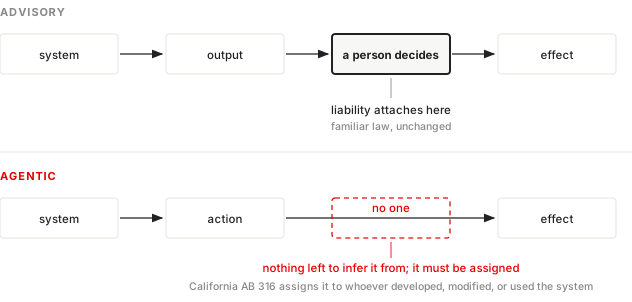
Agents and the identity gap
With an agent, responsibility depends on the profession, contract, statute, role, and facts. Licensed professionals can retain direct duties for competent review and client confidentiality, supervisors can retain duties to establish and verify firm controls, and vendors can carry contractual or statutory duties. What changes immediately is the evidence. When a person acts inside a system, the record says who they were. When an autonomous agent acts, many deployments record only a service account, without the agent, authority, or instruction. Enforcing responsibility takes a record that names those elements, which is why attribution is far from administrative detail.
For the prompts a team sends to supported AI tools, Sentinel, an AI gateway, replaces the identifiers it recognizes before the prompt leaves the computer and records metadata for each request. It records metadata only, so the attribution record described above stays the record of who acted.
Three of the eight stages, by profession
| Stage | Law | Tax | Health |
|---|---|---|---|
| Put client data in | ABA Formal Opinion 512 requires informed consent before information about a representation enters a self-learning tool. | IRS OPR Issue 2026-19 says to use secure, enterprise-approved AI. | HHS requires a BAA before PHI reaches a business associate. |
| Review | Verify every fact, citation, and quotation; In re Martin imposed $5,500 in sanctions on July 18, 2025. | The preparer checks the draft against source records and retains professional judgment. | A clinician checks the draft against the patient record before acting on it. |
| Supervise | The State Bar of California calls for supervisory policies and training. | Circular 230 § 10.36 places procedures and compliance checks on firm leaders. | Set workforce rules, training, and sanctions, and write down permitted uses. |
Where standards are heading
- NIST opened an AI Agent Standards Initiative in February 2026, explicitly addressing agents run without dedicated identity, authorization, or accountability controls.
- Singapore published the first comprehensive governance framework for agentic AI in January 2026, requiring each agent to carry a verifiable identity and an audit trail of which agent acted under whose authority.
- The EU AI Act applies Articles 14 and 15, on human oversight and on system reliability, to autonomous agents in high-risk settings.
The NIST item comes from secondary reporting. Read the primary document before relying on its detail. Singapore's requirements come from the linked primary IMDA framework.
What to check
- List every agent with standing authority to act in your systems, and the identity each one runs under.
- For each, confirm the record can show which agent acted, under whose authority, and on what instruction.
- For each third-party model you deploy, find what the contract says about who carries the risk, and have counsel read it with AB 316 in mind.
Frequently asked questions
- What did California AB 316 change?
- California AB 316, Chapter 672, in effect since January 1, 2026, bars a defendant who developed, modified, or used an AI system from asserting that the system autonomously caused the harm. Civil Code § 1714.46(c) keeps other affirmative defenses and evidence on causation, foreseeability, and comparative fault available. The remaining liability analysis depends on the applicable law and facts.
- What is the difference between developer and operator liability?
- Developer liability runs to whoever designed and trained the system, by analogy to product liability. Operator liability runs to the organization that deployed it, whoever built it. A bank that deploys a third-party model is an operator, and the lab that trained the model is a developer. Which model prevails decides who carries the risk.
- Why is it hard to assign responsibility when an AI agent acts?
- What changes is the evidence. When a person acts inside a system, the record says who they were. When an autonomous agent acts, many deployments record only a service account, without the agent, authority, or instruction. Enforcing responsibility takes a record that names those elements.
- Do professionals keep their own duties when they use AI?
- Yes. Licensed professionals retain duties of competence, confidentiality, and review, while supervisors set and check firm rules. ABA Formal Opinion 512 and IRS OPR Issue 2026-19, issued June 24, 2026, apply those duties to AI use. The page describes public law in general terms and is no substitute for legal advice.
- What should an organization check about its AI agents?
- List every agent with standing authority to act in your systems and the identity each one runs under. Confirm the record can show which agent acted, under whose authority, and on what instruction. For each third-party model you deploy, find what the contract says about who carries the risk, and have counsel read it with AB 316 in mind.
Keep going
What is prompt injection, and how do you defend against it?
Is it safe to let an AI agent act on company systems?
Map one workflow before the next one goes wrong
A practical next step
For regulated work
Sources
- California Assembly Bill 316 (Krell), Artificial intelligence: defenses, chaptered October 13, 2025, effective January 1, 2026. Bars specified defendants from asserting that AI acted autonomously to cause harm and defines AI by whether it infers from input how to generate outputs.
- European Union, Artificial Intelligence Act, Article 3(1); Articles 14 and 15.
- Berkeley Technology Law Journal, Multi-Agent AI is Outpacing the Liability Frameworks Built for Single-Agent Systems, June 2026.
- Singapore IMDA, Model AI Governance Framework for Agentic AI, January 2026. Primary framework on bounding agent access, human accountability, lifecycle controls, and transparency.
- American Bar Association, Formal Opinion 512, Generative Artificial Intelligence Tools, July 29, 2024. Lawyers using generative AI remain responsible for competence, confidentiality, supervision, candor, and reasonable fees.
- US Department of the Treasury, Circular 230, June 12, 2014. Primary rules governing practice before the Internal Revenue Service, including competence and supervisory procedures.
- IRS Office of Professional Responsibility, Introductory Guidelines for Responsible AI Use in Federal Tax Practice, Issue 2026-19, June 24, 2026.
- US Department of Health and Human Services, Business Associates. Primary HIPAA guidance on covered entities' and business associates' responsibilities for protected health information.