The question works because it turns a security question into a location question, and location is a fact. "Secure" is a judgment a vendor makes about itself. "Held in this region, retained this long, never used for training, under this contract term" can be checked by someone who was never in the room.
Four things a complete answer names
- Destination. Where prompts and attached documents are processed and held.
- Retention. How long they are kept.
- Training use. Whether they are used to train or improve a model.
- Contract term. The clause that commits the supplier to the first three, and who is able to change it.
Most prompts do leave the building
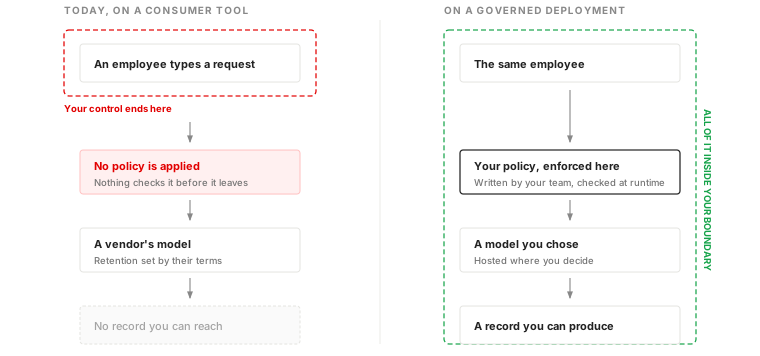
In most enterprise deployments the prompt leaves the organization. That can be perfectly acceptable. The trouble starts when nobody can say where it goes. Then nobody has drawn the boundary, and a rule about data has no edge to be enforced at. For practical examples, follow the guides to stop customer data reaching ChatGPT from a Windows PC and redact PII before an LLM.
When a gateway sits in the path
Bank account numbers, driver's licenses, tax IDs and EINs, national IDs, VINs, dates of birth, and medical record numbers are replaced when a label sits next to them, such as "Account number:" or "MRN:". A local gateway therefore adds no new destination to the four answers above.
How to ask it
That gives the prompt a named destination and places access, configured guardrails, user collections, and the conversation record inside a company-administered workspace. The leadership view explains why AI data exposure is a leadership problem.
- A good answer
- A specific destination, a named retention period, and a clear statement on training use, with a contract term behind it.
- An evasion
- "Your data is secure." "Enterprise-grade privacy." Both answer a question about security. The question was about destination.
- The follow-up
- Show me where that is written down, and tell me who can change it.
What to check
- Take the AI tool your people use most and put the four questions to its supplier in writing.
- Find the contract clause behind each answer. A sales deck or an FAQ describes; the clause commits.
- Ask who on either side can change those terms, and how you would hear about it.
Frequently asked questions
- Where does data go when employees use AI?
- In most enterprise deployments the prompt leaves the organization, which can be acceptable. The trouble starts when nobody can say where it goes. Then nobody has drawn the boundary, and a rule about data has no edge to be enforced at. A complete answer names a destination, a retention period, a statement on training use, and a contract term.
- What four things should a complete answer about AI data name?
- Destination is where prompts and attached documents are processed and held. Retention is how long they are kept. Training use is whether they are used to train or improve a model. Contract term is the clause that commits the supplier to the first three, and who is able to change it. Put each question to the supplier in writing.
- Why is "your data is secure" not an answer?
- Secure is a judgment a vendor makes about itself, and it answers a question about security. The question was about destination. A statement such as held in this region, retained this long, never used for training, under this contract term can be checked by someone who was never in the room.
- Does a local gateway add a new destination for AI prompts?
- No. A local gateway such as SUPERWISE Sentinel checks each prompt on the PC before it leaves. Prompts go straight to the AI provider; SUPERWISE receives only check metadata. It therefore adds no new destination to the four answers above.